
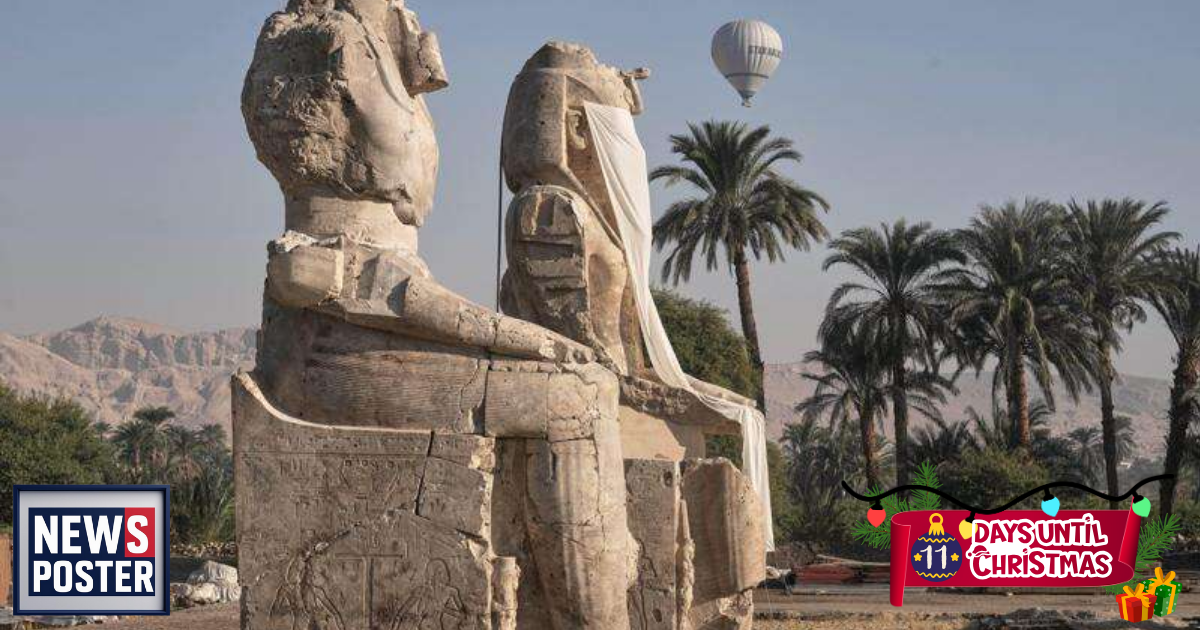
Egypt unveiled the restored Colossi of Memnon in Luxor on Sunday, showcasing two colossal statues of Pharaoh Amenhotep III as part of ongoing efforts to attract more tourists to the country.
The giant alabaster statues, which were reassembled after nearly two decades of restoration, date back some 3,400 years and once stood at the entrance of Amenhotep III’s mortuary temple. The pharaoh, who ruled during Egypt’s prosperous New Kingdom from 1390–1353 BC, oversaw a period of peace, wealth, and extensive construction, including the temples at Luxor and Soleb in Nubia.
The statues were toppled by an earthquake around 1200 BC, leaving them fragmented and partially quarried, with some blocks reused in the Karnak temple. Archaeologists later recovered and rebuilt the pieces, starting with a joint Egyptian-German project in the late 1990s. The statues depict Amenhotep III seated, hands on his thighs, facing east toward the Nile, adorned with the nemes headdress, double crowns, and a pleated royal kilt. Small statues of his wife, Tiye, rest at his feet.
Standing 14.5 meters and 13.6 meters tall, the colossi guard the entrance to what is believed to be Egypt’s largest temple complex, covering 35 hectares on the Nile’s western bank. Hewn from Hatnub alabaster, the statues were partly constructed from separately carved pieces fixed into monolithic cores.
The unveiling follows the recent opening of the Grand Egyptian Museum near the Giza Pyramids, another major initiative to revive tourism, a key contributor to Egypt’s economy. Tourism has rebounded in recent years after political unrest, the COVID-19 pandemic, and global conflicts affected visitor numbers.
Tourism and Antiquities Minister Sherif Fathy hailed the site as a lasting attraction. In 2024, Egypt welcomed a record 15.7 million tourists, contributing roughly 8% of GDP. Authorities are projecting 18 million visitors in 2025, aiming to reach 30 million annually by 2032.