
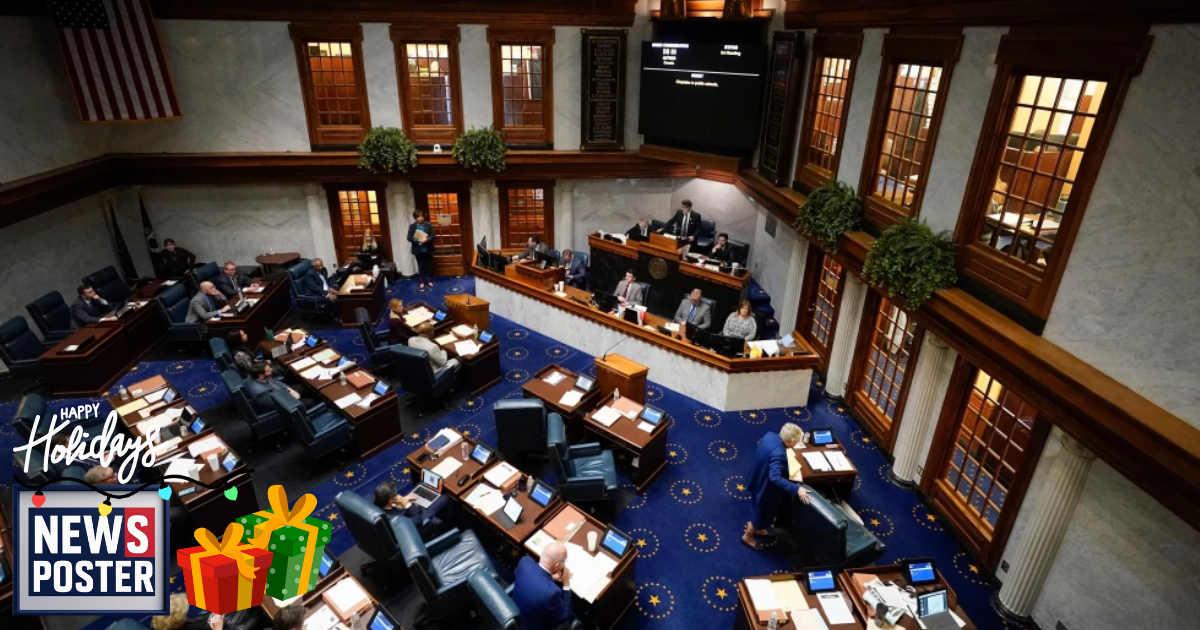
A proposal to redraw Indiana’s congressional map is facing its first public test in the state Senate on Monday, with uncertainty over whether it can pass a final vote later in the week despite months of pressure from former President Donald Trump. The bill is designed to favor Republican candidates in the 2026 midterm elections, but some GOP senators, who control the chamber, have expressed hesitation or opposition to a mid-decade redistricting effort. Several have also faced threats for their stance or reluctance to declare support.
Monday’s committee hearing is expected to reveal which senators are willing to go on record against the plan, providing an early look at whether Trump’s influence over the state Republican Party remains strong. The map, introduced last week and passed by the Republican-controlled state House on Friday, would split Indianapolis into four districts and combine East Chicago and Gary with large swaths of rural northern Indiana. The proposed boundaries would eliminate the districts of the state’s two Democratic representatives: longtime Rep. André Carson, who represents Indianapolis and is the state’s only Black member of Congress, and Rep. Frank Mrvan, representing northwest Indiana near Chicago. Republicans currently hold seven of the state’s nine congressional districts.
Redistricting is normally done once a decade following the census, but Trump has urged Republican-led states to redraw maps mid-cycle to secure additional winnable districts. Several states, including Texas, Missouri, Ohio, and North Carolina, have pursued similar efforts, while Democrats in California and Virginia have redrawn districts to their advantage. In Indiana, however, many GOP senators remain uneasy about altering the map approved in 2021. Senate leadership previously indicated there were not enough votes to pass redistricting, and the exact tally heading into Monday remains unknown.
Lawmakers are scheduled to meet on the Senate floor at 12:30 p.m., with the Senate elections committee convening at 1:30 p.m. The White House has intensified pressure, with Vice President JD Vance visiting Indianapolis twice since August and legislative leaders meeting with Trump earlier this year. After Senate leader Rodric Bray rejected a special session call on redistricting, Trump criticized him and other senators on social media and promised to endorse primary challengers to any lawmaker who opposes the plan. In recent weeks, about a dozen lawmakers have faced threats and swatting incidents.
In the 50-member Senate, supporters need at least 25 votes to pass the map, which would trigger a tiebreaking vote from Republican Lt. Gov. Micah Beckwith, who supports redistricting. A Senate rejection would make it extremely difficult to advance the plan again, as the filing deadline for congressional candidates is in early February and primaries are set for early May.