
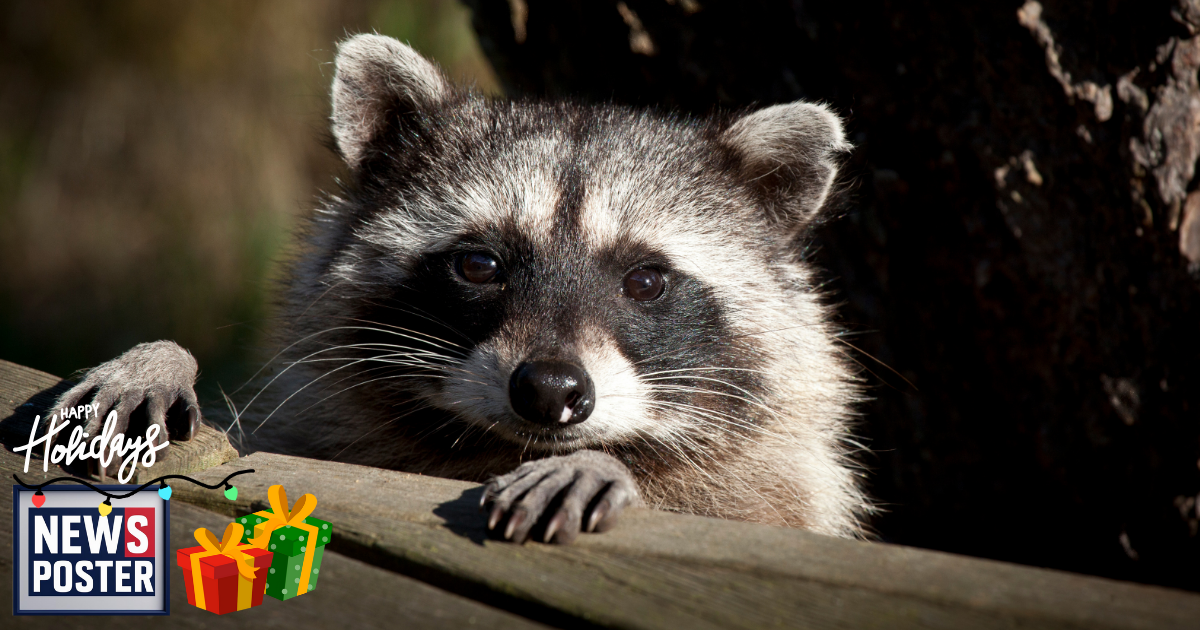
Raccoons rummaging through urban trash may be more than just a clever nuisance—they could be showing early signs of domestication. A recent study suggests that raccoons living near humans are undergoing physical changes similar to those seen in the ancestors of dogs and cats.
Researchers analyzed nearly 20,000 images of raccoons from across the continental United States and found that urban raccoons have noticeably shorter snouts compared with their rural counterparts. Shorter snouts are a hallmark of “domestication syndrome,” a suite of physical traits—including altered coat patterns, smaller teeth, changes in ears and tails, and craniofacial shifts—that tend to emerge as animals become calmer, more tolerant, and less aggressive toward humans.
The study, led by Raffaela Lesch of the University of Arkansas at Little Rock and published in Frontiers in Zoology, suggests that simply living near humans can drive these changes. A key factor appears to be access to human food waste. Raccoons that are less fearful of people are more successful at reaching trash cans, gaining an evolutionary advantage that gradually influences physical traits such as snout shape.
“This could be a case where our next domesticated species is raccoons,” Lesch said. “It would be fitting—and funny—if we called the domesticated version the trash panda.”
The research also involved 16 college and graduate students as co-authors, reflecting significant student participation. The team is now validating photo-based measurements through 3D scans of raccoon skulls and expanding the study to other urban mammals, including armadillos and opossums, to determine if similar evolutionary patterns are occurring.