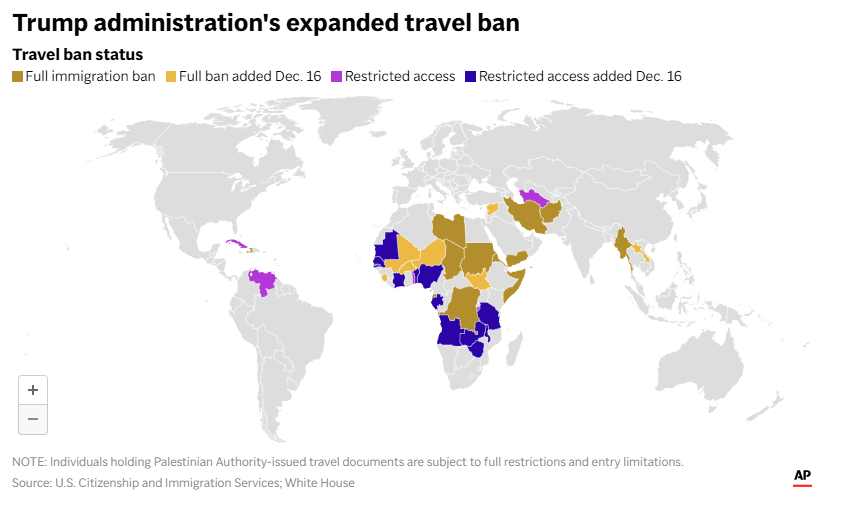
WASHINGTON – The Trump administration announced a major expansion of U.S. travel restrictions on Tuesday, adding 20 more countries and imposing a full ban on people traveling with documents issued by the Palestinian Authority. The decision doubles the scope of limits unveiled earlier this year and significantly broadens who is barred from entering or immigrating to the United States. Under the new proclamation, five additional countries were placed under a complete travel ban, while 15 others were added to a list facing partial restrictions. The administration said the changes will take effect on Jan. 1 and apply to both short-term visitors and those seeking to permanently relocate to the U.S., with exemptions for lawful permanent residents, existing visa holders, diplomats, athletes, and individuals whose entry is deemed to serve U.S. interests.
The expanded ban builds on restrictions announced in June, when President Donald Trump revived a signature policy from his first term by barring citizens from 12 countries and limiting travel from seven others. The latest update fully bans travel from Burkina Faso, Mali, Niger, South Sudan, and Syria, and also blocks entry for individuals using Palestinian Authority–issued travel documents. Another 15 countries — including Nigeria, Senegal, Angola, Tanzania, and Zimbabwe — were added to a partial restriction list. The administration said the affected nations were selected due to concerns over unreliable civil documentation, corruption, high visa overstay rates, refusal to accept deported citizens, and broader issues related to government stability, immigration enforcement, and national security.
Administration officials also pointed to recent security incidents, including the arrest of an Afghan national accused of shooting two National Guard troops near the White House, as part of the context for tightening entry standards. That suspect has pleaded not guilty to murder and assault charges. In the wake of the incident, the administration rolled out additional immigration measures, including tougher rules affecting people from countries already under restrictions. Critics argue the policy unfairly targets people based on nationality rather than individual risk, warning that it will separate families, disrupt education and employment plans, and undermine humanitarian commitments.
Advocacy groups have raised particular concern about the removal of an exception for Afghans eligible for Special Immigrant Visas, a program designed for those who assisted U.S. forces during the war in Afghanistan. Supporters of the program say these individuals undergo extensive vetting and face serious danger in their home country because of their cooperation with the United States. They argue that blocking their entry not only breaks longstanding promises but also weakens U.S. credibility abroad. The administration maintains that the changes are necessary to ensure consistent vetting standards and protect national security.
International reaction began to emerge shortly after the announcement, with officials from several newly affected countries saying they were reviewing the decision and seeking clarification from U.S. authorities. Some governments described the move as serious and urgent, signaling potential diplomatic discussions ahead. The administration also adjusted restrictions for countries previously on the list, tightening limits for some while easing conditions for others it said had improved their vetting processes.
The new measures further tighten restrictions on Palestinians, expanding earlier rules that sharply limited travel for holders of Palestinian Authority passports. Under the updated policy, those documents can no longer be used to immigrate to the United States at all. The administration said the decision was driven by security concerns, citing the presence of U.S.-designated terrorist groups in the West Bank and Gaza Strip and warning that the ongoing conflict has compromised screening capabilities in the region.